
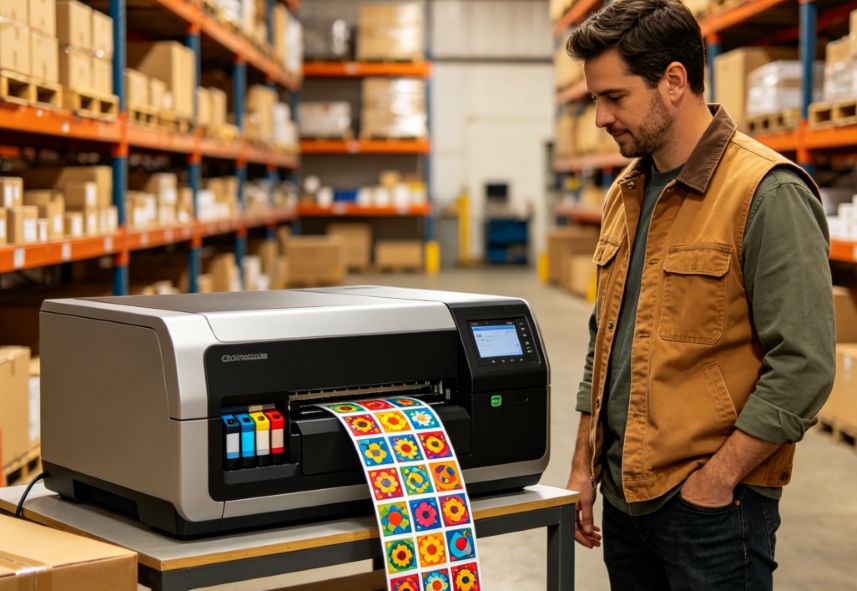
Small and mid-sized businesses spend a meaningful share of their packaging budget on labels, and the choice of how to produce them shapes that budget for years. Two paths dominate the decision: sending artwork to an outside print shop, or bringing production in-house with dedicated equipment. Each path carries its own mix of upfront cost, ongoing expense, and operational tradeoff.
Businesses exploring the in-house route often start by researching equipment options, including DuraFast inkjet labels, to understand what a self-managed setup actually requires before committing budget to it.
The Case for Outsourcing
Outsourcing remains the default choice for many companies, particularly those just starting out or those with unpredictable label needs. The appeal is straightforward: no equipment to buy, no maintenance schedule to manage, and no need to train staff on color calibration or media handling. Analysis from SnapPress notes that outsourced printing lets businesses avoid the upfront costs of purchasing printing equipment and supplies, which can make it an attractive option when a company wants to minimize initial investment.
There is also a quality argument. Commercial print shops typically operate offset or flexographic presses that professional printers spend years learning to run well. Research published by JinXinCai Printing found that outsourced offset printing can achieve tighter color accuracy, with Delta E values under 2.0, a level of precision that is difficult for a small operation to match with a desktop printer.
The tradeoff shows up in flexibility. Findings from ID Technology point out that outsourcing partners are generally set up for larger, more complex jobs rather than quick small-batch requests, and vendor lead times commonly run in the range of eight to ten days according to reporting from ARR Systems. That gap between placing an order and receiving finished labels can be a real constraint for businesses that need to react quickly to changing packaging requirements or sudden demand.
The Case for In-House Printing
Bringing inkjet label printing in-house flips the cost structure. The business absorbs the equipment purchase and the ongoing cost of ink and media, but gains control over timing, quantity, and design changes. A business can print ten labels or ten thousand without waiting on a vendor’s production schedule, and mistakes can be caught after a short test run rather than discovered in a completed bulk shipment.
Data from VIPColor indicates that color label printers designed for business use are now available at accessible price points, which has lowered the barrier for smaller operations to bring production in-house. Industry pricing analysis compiled by Custom Printing Co. places the typical cost of in-house color inkjet printing between eight and fifteen cents per label, depending on stock and ink usage, a figure that becomes more competitive as order volume rises and the equipment cost is spread across more units.
Speed is the other major factor. Eliminating shipping time and vendor queues means labels can be produced the same day a design changes or an order comes in, which matters for businesses managing frequent SKU updates, promotional runs, or regulatory changes such as the GHS chemical labeling updates that took effect in mid 2026.
Where the Decision Tends to Land
Neither approach is universally better, and the right choice usually comes down to three factors. Because label production ties directly into packaging budgets, order fulfillment, and cash flow, it is a decision best made alongside the broader forecasting and cost planning that goes into a well-structured business plan, rather than in isolation.
- Order volume. Guidance from Custom Printing Co. suggests the breakeven point for investing in in-house equipment tends to fall around 50,000 labels annually, or roughly $1,500 in monthly label spend. Below that threshold, outsourcing’s lower fixed costs often win out, factoring in equipment depreciation and labor.
- Label variety. Businesses that print many different label designs, sizes, or short runs benefit from the flexibility of in-house printing, since outsourcing partners frequently impose minimum order quantities that force bulk purchases of a single design.
- Brand control. Companies that update packaging often, need fast turnaround on compliance labeling, or want tight oversight of color consistency across products tend to favor bringing production in-house, even at somewhat higher per-unit cost for smaller runs.
Looking Ahead
As label printing technology becomes more affordable and easier to operate, the calculation is shifting for many small and mid-sized businesses. What once required outsourcing by default is increasingly practical to manage internally, provided a company has enough consistent volume to justify the investment. Businesses evaluating their options are best served by tracking their actual annual label spend and variety of designs before choosing a direction, since the right answer depends less on which method is inherently better and more on how a specific operation actually uses labels day to day.